Jojoba oil is a common ingredient in hair care products, yet few people know that its chemical composition differs significantly from that of other plant oils. What is more, it bears a striking resemblance to the natural oil produced by human skin.
What makes jojoba special? How does it work on the surface of the hair, and what does modern science tell us about its properties?
To answer these questions, we first need to get to know the plant itself and its unique composition.
Where does jojoba oil come from?
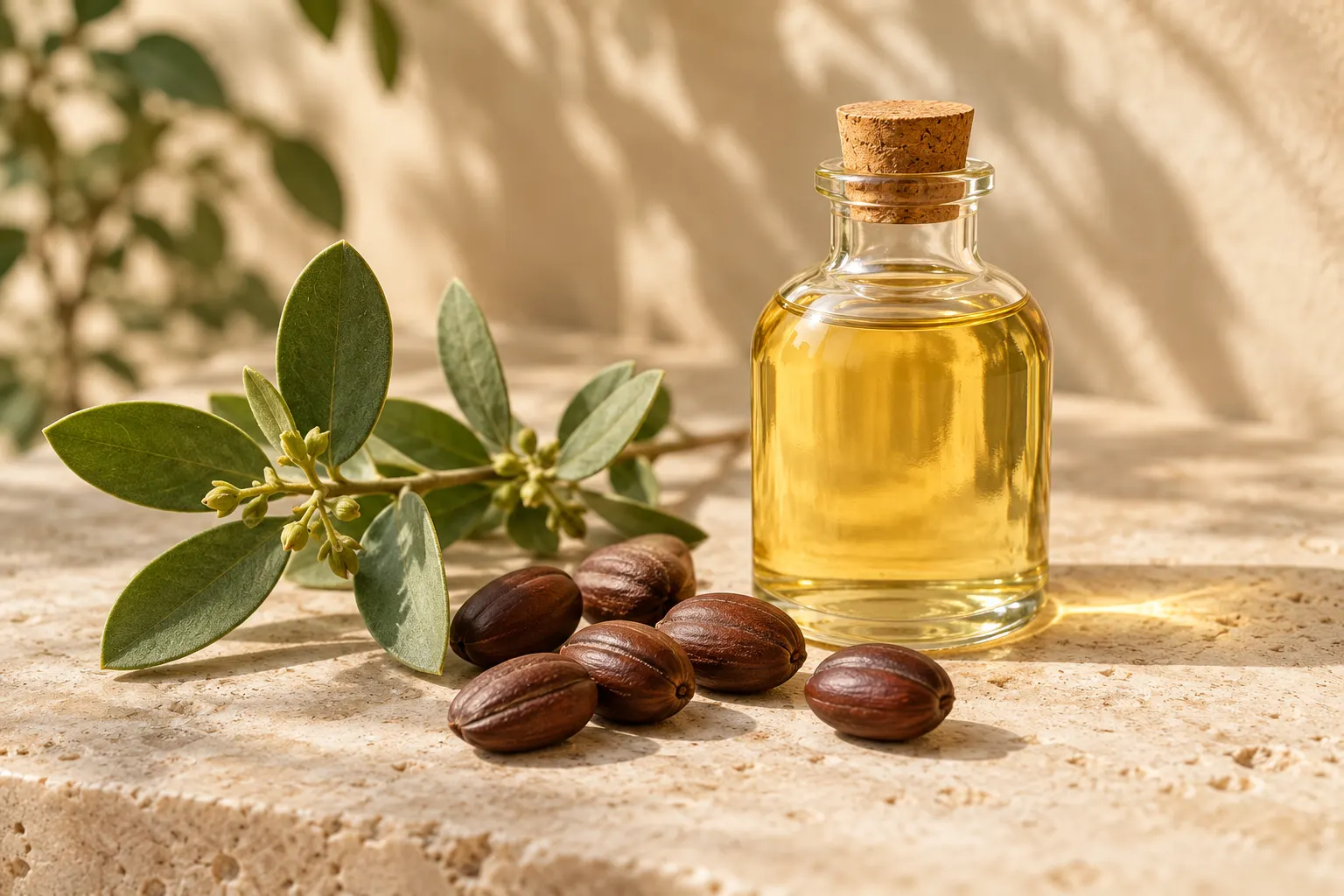
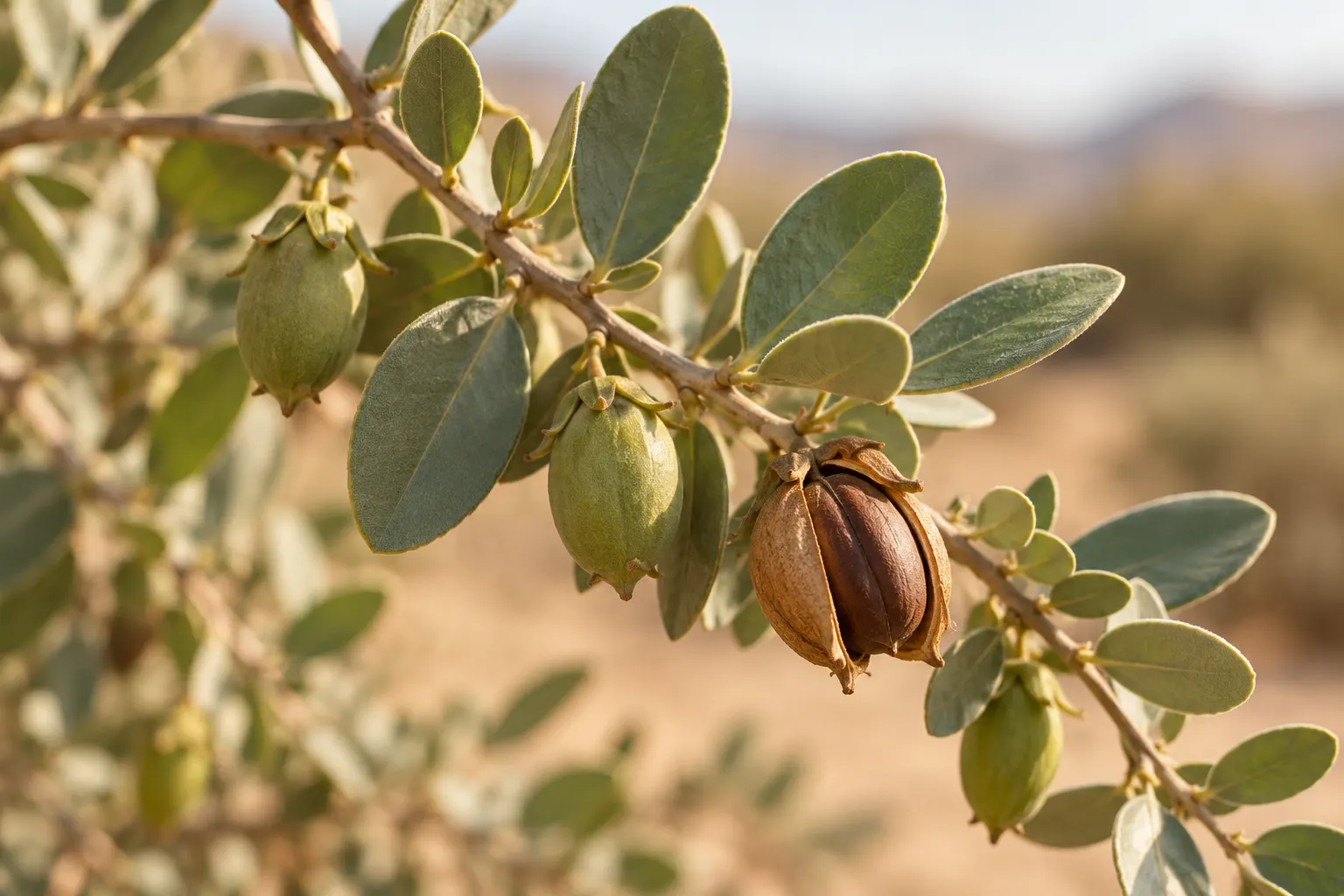
Jojoba (Simmondsia chinensis) is an evergreen shrub that grows naturally in the arid regions of North America, particularly the southwestern United States and northwestern Mexico. [5]
One of its distinctive qualities is its ability to adapt to harsh desert conditions.
Jojoba oil is obtained from the plant's seeds, which are particularly rich in waxy substances. Scientific data indicate that these substances account for approximately 40–60% of the dry weight of mature seeds. [2]
The plant's name has an interesting history, too: although the Latin chinensis suggests a connection to China, jojoba did not originate there. The name arose from historical botanical classification and has remained in use ever since. [5]
Is jojoba oil actually an oil?
This is one of the most interesting scientific facts about jojoba.
Most conventional plant oils, such as coconut or olive oil, consist mainly of triglycerides.
Jojoba, however, has a very different composition.
According to a scientific review published in Polymers in 2021, approximately 98% of jojoba oil consists of waxy components, most of which are wax esters. [1]
Wax esters form when long-chain fatty acids chemically combine with fatty alcohols.
Despite the word "wax," jojoba is liquid at room temperature. This is why we still call it an oil in everyday language and in the cosmetics industry. [1]
This distinctive molecular structure is responsible for many of its interesting physical and cosmetic properties.
What does jojoba have in common with the skin's natural oil?
Our skin produces a natural oily substance called sebum.
Sebum helps form the protective layer on the skin's surface and helps maintain its suppleness and oil balance.
Interestingly, sebum also contains wax esters-the very compounds that make up most of jojoba oil.
A scientific review published in the International Journal of Cosmetic Science in 2022 pays particular attention to the structural similarities between jojoba's wax esters and certain components of human sebum. [2]
However, this does not mean that jojoba oil is an exact equivalent of the skin's natural oil. Sebum is a much more complex mixture that also contains other lipids.
Why is this of interest in cosmetics?
Jojoba's waxy composition makes it a useful emollient ingredient in a variety of skin and hair care formulations.
But there is an important distinction: chemical similarity to natural sebum does not, in itself, mean that jojoba regulates oil production or treats an oily scalp.
How does jojoba act on the hair shaft?
To understand why jojoba is used in hair care products, it helps to revisit the structure of hair.
The outer layer of the hair is called the cuticle. It consists of overlapping cells and protects the hair's internal structure. [3]
When the cuticle's surface is damaged, hair often becomes rough, loses its smoothness and tangles more easily.
According to a review published in the International Journal of Trichology in 2015, oils, waxes and other conditioning ingredients are used in hair care products to reduce friction between hair strands and make combing easier. [3]
Jojoba oil's cosmetic role is similarly linked to its emollient properties and its effects on the hair's surface. [1]
Its use may help:
- soften the hair's surface;
- reduce the feeling of roughness;
- allow strands to glide past one another more easily;
- give hair a smoother, well-cared-for appearance.
It is especially important not to confuse these cosmetic effects with complete restoration of the hair's internal structure.
At present, high-quality clinical studies specifically examining jojoba oil's effects on hair are limited. The scientific rationale for its use is largely based on its known chemical properties and the general mechanisms of hair conditioning.
Why is jojoba oil so stable?
Another interesting property of jojoba is its resistance to oxidation.
The quality of plant oils can change over time as they interact with oxygen, light and heat. This process is known as lipid oxidation.
Jojoba's distinctive molecular composition gives it relatively high resistance to this process.
A study published in Antioxidants in 2026 compared the oxidative stability of jojoba, olive, sunflower and rosehip oils. [4]
In a specialised laboratory test at 100°C, the researchers measured the time each oil took to reach the onset of rapid oxidation.
The results were as follows:
- Jojoba oil - approximately 39.8 hours;
- Olive oil - 27.5 hours;
- Sunflower oil - 10.4 hours;
- Rosehip oil - 4.5 hours.
Among the four oils tested, jojoba showed the greatest resistance to oxidation. [4]
This finding is particularly interesting for cosmetic formulation, as ingredient stability is one of the important factors in maintaining product quality.
However, this was an accelerated laboratory test, rather than a measurement of the oils' actual shelf life. The stability of a finished cosmetic product also depends on its overall formulation and packaging. [4]
Does jojoba oil speed up hair growth?
Online claims about jojoba often suggest that it speeds up hair growth, stops hair loss or completely repairs damaged hair shafts.
There is, however, a difference between these promises and scientifically established properties.
At present, there is insufficient high-quality clinical evidence that jojoba oil, on its own, accelerates human hair growth or treats hair loss.
Its emollient action may be useful in everyday hair care, but this does not mean that the oil repairs an already damaged keratin structure.
Applying oil may also temporarily make the hair's surface smoother, but it cannot permanently seal ends that have already split.
How should you use a hair oil that contains jojoba?
When using a hair oil, the amount matters as well as the type of ingredient.
A small amount of an oil-based product may give hair a pleasant softness and a smooth appearance, while too much can weigh hair down, especially fine hair.
Depending on the product's instructions, a leave-in hair oil is generally applied to the lengths and ends.
It is best to start with a small amount and distribute it evenly.
The final effect depends on hair type, the amount used and the product's overall formulation.

Why is jojoba oil part of DIVARA's formula?
DIVARA hair oil combines five natural oils, one of which is jojoba.
One reason for choosing it is its distinctive chemical structure and its well-established role as an emollient in cosmetics.
Jojoba's waxy components are of interest in formulations designed to give hair greater softness, smoothness and a well-cared-for appearance.
We believe it is important for customers to understand why a particular ingredient is used and what they can realistically expect from it.
Jojoba oil is not a universal solution to every hair concern, but its unique chemical composition and cosmetic properties make it an interesting hair care ingredient.
You will discover many more facts like these on the DIVARA blog-because better hair care begins with a better understanding of your hair.
Scientific sources
1. Gad H.A. et al. (2021) - Jojoba Oil: An Updated Comprehensive Review on Chemistry, Pharmaceutical Uses, and Toxicity.
Journal: Polymers.
Full scientific review - PubMed Central
2. Blaak J., Staib P. (2022) - An updated review on efficacy and benefits of sweet almond, evening primrose and jojoba oils in skin care applications.
Journal: International Journal of Cosmetic Science.
Read the scientific review - Wiley
3. Dias M.F.R.G. (2015) - Hair Cosmetics: An Overview.
Journal: International Journal of Trichology.
Scientific review of hair care cosmetics - PubMed Central
4. Fagoaga C. et al. (2026) - Oxidative Stability and Kinetics of Oxidation of Rosehip, Sunflower, Olive and Jojoba Oils.
Journal: Antioxidants.
5. Oregon State University - Simmondsia chinensis.
Botanical information about the jojoba plant and the origin of its name.
This article is for educational purposes. The studies discussed concern jojoba oil's chemical properties and general cosmetic uses, rather than clinical trials of DIVARA's finished formula.