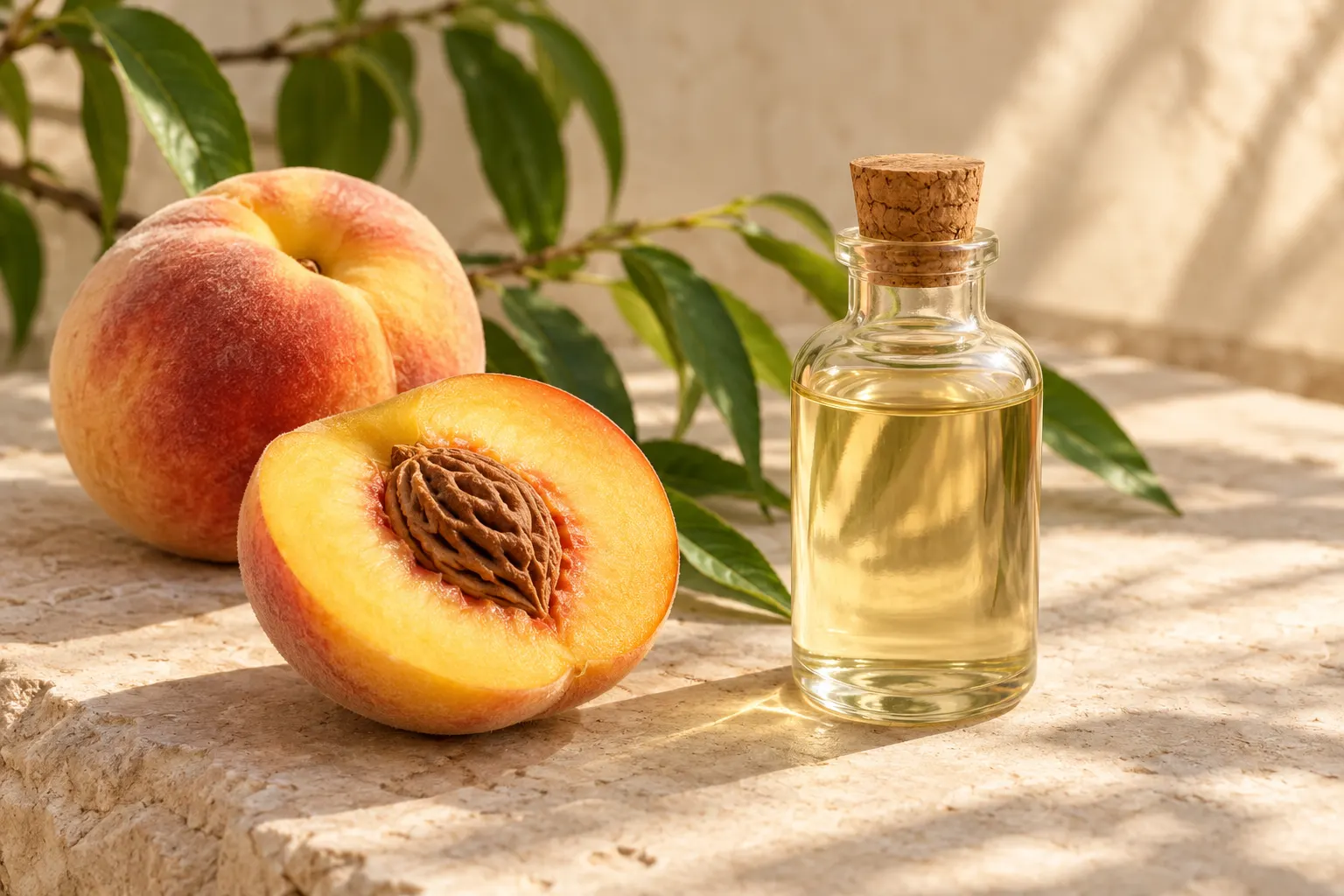
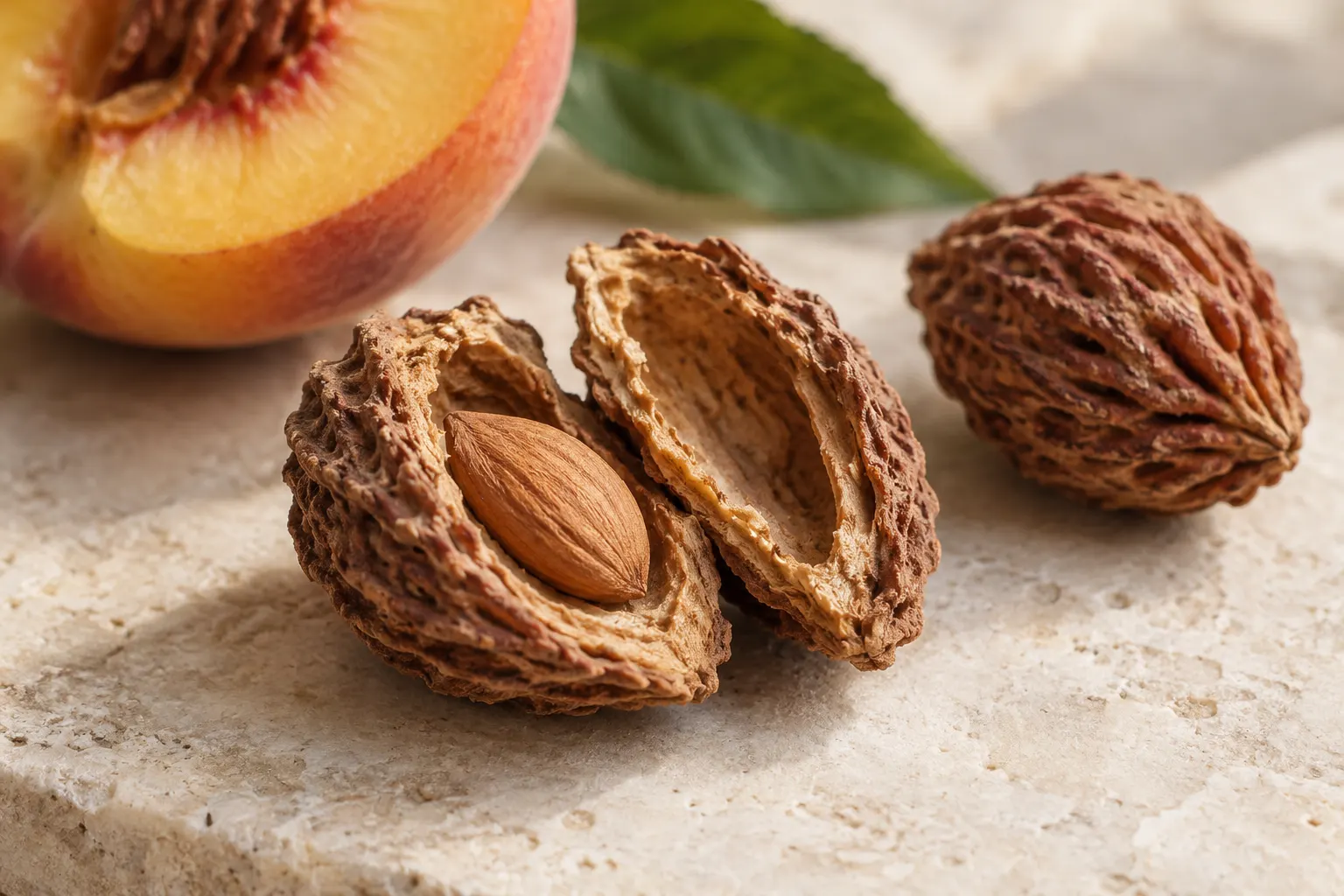
Peach flesh is familiar to us all. Yet inside its hard stone lies a small kernel, from which an oil used in cosmetics is extracted. This is where the fruit’s second, less familiar story begins: its journey from edible fruit to a care ingredient. [1] [2]
To understand peach oil’s role in a hair care formula, three questions are worth exploring: what it contains, how it may act on the hair’s surface, and which effects have been studied directly. This makes its properties and uses easier to understand.
Oil from the kernel
On product ingredient lists, peach kernel oil often appears as Prunus Persica (Peach) Kernel Oil. This name is also listed in the Cosmetic Ingredient Review ingredient database. [1]
The word “kernel” refers to the seed found inside the stone. Studies of the oil examine the fatty fraction extracted from this kernel. [2]
This origin also has practical significance: the stones left after fruit processing gain another potential use. Recent papers on peach and apricot kernel oils also consider them as potential cosmetic raw materials. [4]
Two important components: oleic and linoleic acids
Unsaturated fatty acids make up a significant part of peach kernel oil. Oleic and linoleic acids are often prominent among them and help shape the differing properties of plant oils. [2] [4]
In a study published in LWT - Food Science and Technology in 2011, the main fatty acids in one of the samples examined were oleic acid, at approximately 61.9%, and linoleic acid, at approximately 29.1%. Unsaturated fatty acids accounted for approximately 91% of the total. [2]
These figures relate to a specific sample in that study. The scientists obtained the oil through laboratory extraction and compared different solvents. The numbers should therefore not be treated as a fixed composition shared by every cosmetic bottle.
Understanding an oil’s properties benefits from knowing both its origin and how it was obtained. The same botanical name does not always mean an identical chemical profile.
What does research on two peach varieties show?
A paper published in the Journal of Oleo Science in 2024 studied kernel oil from two peach varieties grown in Tunisia, Sweet Cap and O’Henry. The researchers examined the lipid profile, phenolic compounds, and antioxidant capacity. [3]
The samples contained tocopherols, compounds in the vitamin E family, as well as phenolic components. Antioxidant activity measured in different tests varied between the varieties. These results show that peach oil has a chemical composition of interest for further study. [3]
An antioxidant test evaluates how a sample behaves under defined laboratory conditions. Hair shine, ease of combing, and reduced hair shedding are different outcomes that require appropriate trials to assess.
Such research therefore provides a useful basis for further study of the ingredient, while the effects of a particular hair care product require separate evaluation.
One name, different samples
In a study published in Food Bioscience in 2025, scientists compared cold-pressed peach and apricot kernel oils with commercial samples. They examined fatty acids, tocopherols, phenolic compounds, and volatile compounds. [4]
The results showed both common features, including substantial proportions of oleic and linoleic acids, and differences between samples. The authors note that processing and storage conditions, alongside the botanical source, may also influence the aroma profile. [4]
How does this relate to softer hair?
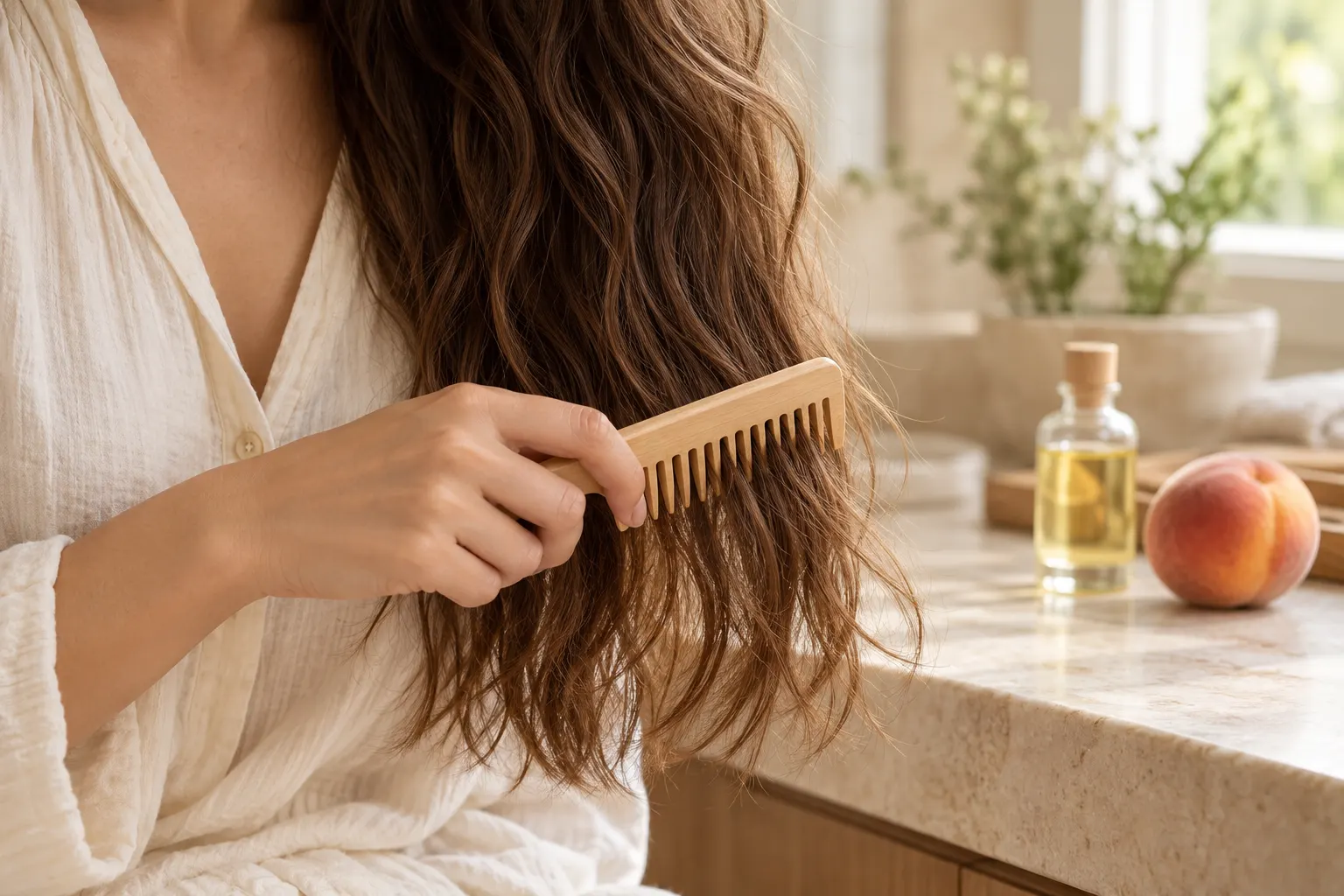
The hair’s outer layer, the cuticle, consists of overlapping cells. The condition of its surface influences friction between strands and how the hair behaves during combing. [5]
The 2015 scientific review Hair Cosmetics: An Overview describes the role of conditioning ingredients: lubricating the hair’s surface, reducing friction, and making combing easier. Oils and waxes are among these ingredients. [5]
Plant-derived fatty oils are used in cosmetics for their emollient properties. Interest in peach kernel oil likewise relates to its composition and its potential use in such formulas. [4] [6]
This provides a reasonable basis for expecting a softening care effect. However, the general mechanism of hair conditioning should be distinguished from results obtained specifically with peach oil: clarifying the ingredient’s effects requires tests on the ingredient itself and on the relevant formula.
Softness, a well-cared-for appearance, and realistic expectations
Pleasant cosmetic effects on hair may include a softer feel, less friction, and easier combing. These outcomes matter in daily care, and the product’s entire formula influences them. [5]
The chemical studies of peach oil discussed here did not measure faster hair growth or the treatment of hair loss. The presence of fatty acids and antioxidant components alone is not enough to substantiate such claims. [2] [3] [4]
For the same reason, finding a particular tocopherol in a sample does not yet tell us how a finished product containing it will perform on an individual’s hair. The amount, interactions with other ingredients, and directions for use all matter.
A few steps for proper use
When choosing a product containing peach oil, start with its intended purpose.
- Read the instructions and begin with a small amount.
- Apply a leave-in product evenly through the lengths and ends, following its directions.
- Notice how your hair feels: aim for softness and easy manageability; reduce the amount if your hair feels weighed down.
- Avoid forceful pulling when combing, and gently work through tangles.
- Base your final choice on the complete formula and your hair’s needs.
Applying a small amount evenly is a more considered starting point than expecting one ingredient to solve every problem. Everyday habits also contribute to the effects of a care routine.
A small kernel with a big story
Peach kernel oil’s appeal lies in the combination of its origin and chemistry. The fatty components concentrated in this less noticeable part of the fruit offer an interesting raw material for cosmetic formulas.
Exploring ingredients like this on the DIVARA blog helps us approach care more thoughtfully: understanding where an oil comes from, what has already been studied, and which effects need further evaluation.
The peach stone’s second life begins with this curiosity: discovering a less familiar possibility within an ordinary fruit and connecting it with realistic, enjoyable daily care.
References
1. Cosmetic Ingredient Review. Prunus Persica (Peach) Kernel Oil: ingredient name and database entry.
View the ingredient entry - CIR
2. Wu H. et al. (2011). Extraction, physicochemical composition, and antioxidant properties of peach kernel oil. LWT - Food Science and Technology, 44(10), 2032-2039.
3. Landolsi C. et al. (2024). Unsaponifiable components, phenols, and laboratory activity of peach kernel oil. Journal of Oleo Science, 73(6), 865-874.
4. Carrà F. et al. (2025). Comparison of bioactive and volatile components in cold-pressed peach and apricot kernel oils. Food Bioscience, 68, 106585.
Study description - the authors’ university resource
5. Dias M.F.R.G. (2015). Hair Cosmetics: An Overview. A review of hair structure and conditioning mechanisms. International Journal of Trichology, 7(1), 2-15.
Read the hair care review - PubMed Central
6. Burnett C.L. et al. (2017). Safety assessment of plant-derived fatty oils as used in cosmetics. International Journal of Toxicology, 36(Suppl. 3), 51S-129S.
View the assessment of plant oils
This article is for educational purposes. Research on the chemical composition of peach oil and the general mechanisms of hair conditioning are discussed separately. They do not constitute a clinical trial of a finished DIVARA product.