Coconut oil has long been used in hair care. Its popularity, however, is about more than pleasant softness and a tropical scent: scientists are studying how it penetrates the hair shaft and whether it can reduce the loss of protein material.
What sets coconut oil apart from other oils? What do laboratory studies show, and what can we expect from everyday use? The answers begin with its origin and composition.
Where does coconut oil come from?
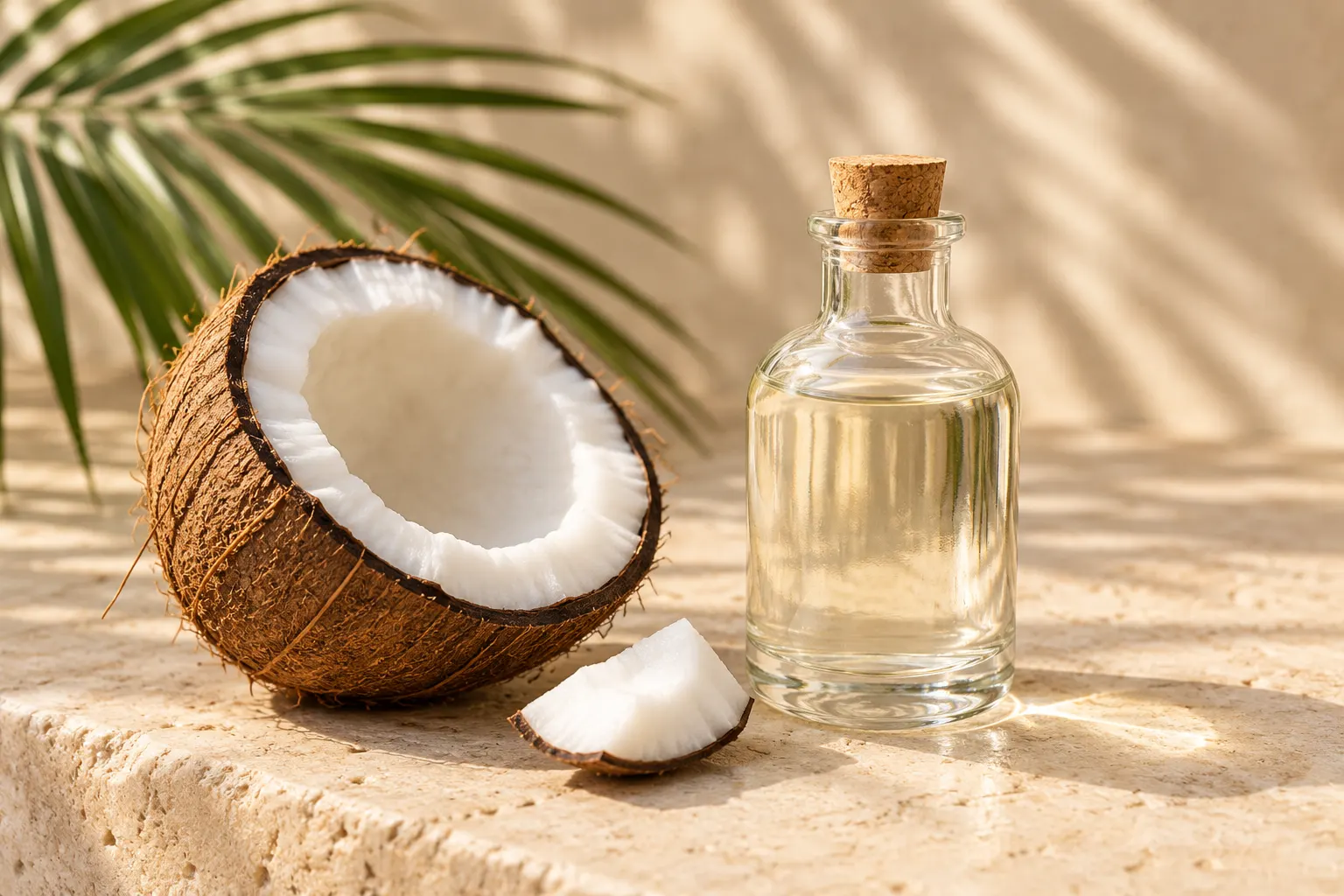
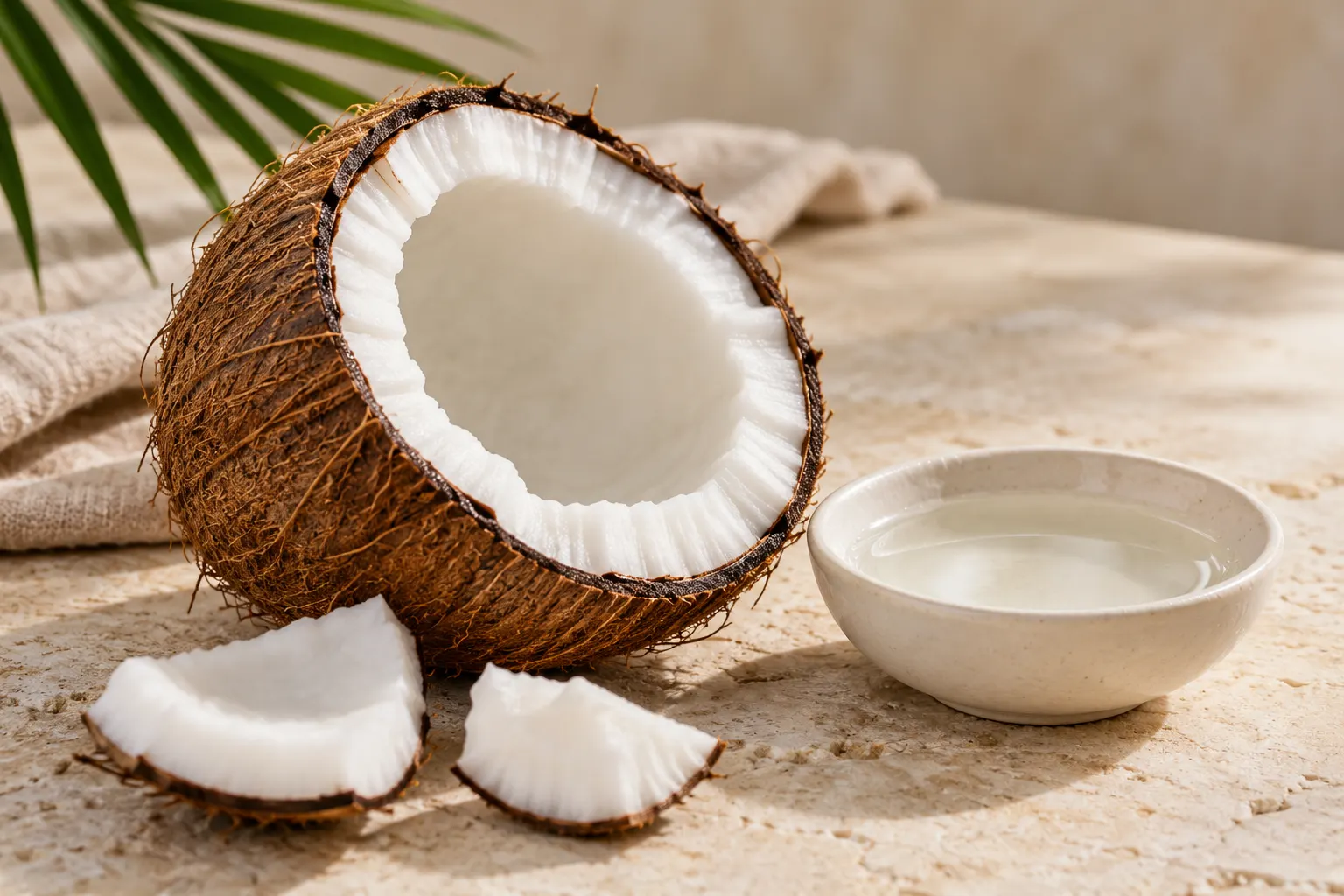
The coconut palm (Cocos nucifera) is a tropical plant, and the white flesh of its fruit is the source of coconut oil. This origin is also described in the Codex Alimentarius standard for vegetable oils. [1]
Interestingly, in botanical terms, a coconut is not a true nut: it is a type of drupe, or stone fruit. Its outer covering, fibrous layer, white flesh and the liquid inside are distinct parts. [2]
Coconut water, coconut milk and coconut oil are therefore different products. When assessing the properties of the oil, we need to focus on its fat composition.
What is special about its composition?
Like argan oil, coconut oil consists mainly of triglycerides. These molecules are made up of glycerol and fatty acids.
Lauric acid is particularly important in coconut oil. In the Codex table, it accounts for approximately half of the fatty acids. This does not mean that half the bottle is free lauric acid: the figure describes the oil's fatty acid composition. [1]
The structure of triglycerides rich in lauric acid, together with their interaction with hair proteins, is considered one possible explanation for coconut oil's ability to penetrate the hair shaft. Understanding these molecular characteristics alone, however, is not enough to establish an effect: studies on hair are also needed. [3]
How was coconut oil penetration into the hair shaft studied?
An oily layer remaining on the surface of the hair and oil penetrating inside the shaft are different phenomena. Both may matter in hair care, but distinguishing between them requires a research method.
In a study published in the Journal of Cosmetic Science in 2001, scientists examined cross-sections of hair treated with coconut oil and mineral oil. Using a specialized mass spectrometry method, they observed the distribution of chemical signals associated with the oils. [4]
The results indicated that coconut oil penetrated the hair shaft, whereas such penetration was not detected for mineral oil in the same study.
This provides a basis for discussing a specific mechanism. At the same time, the study alone cannot determine how noticeable the effect will be on an individual's hair or how much oil would be optimal for them.
What does the 2003 study show about protein loss?
Keratin proteins are the main structural material of the hair shaft. Loss of protein material is therefore one of the measures used to assess hair damage.
In 2003, Aarti S. Rele and R. B. Mohile compared the effects of coconut, sunflower and mineral oils on hair in different conditions. Under the conditions studied, coconut oil reduced protein loss in both undamaged and damaged hair when used before and after washing. [3]
The main finding is that coconut oil can reduce the loss of protein material from hair under certain experimental conditions.
The context of the research also matters when interpreting the results. The authors worked in the research department of a hair care product manufacturer. This does not invalidate the data in itself, but independent studies and testing of different formulations help strengthen the conclusions.
What does the 2022 study say about hair porosity?
A study published in the International Journal of Cosmetic Science in 2022 examined coconut oil-based hair oils. The scientists observed changes in hair porosity and mechanical properties under simulated washing conditions. [5]
They used a method for measuring porous structure, tested the strength of individual hair fibers and also assessed color retention. In the tests, the formulations used limited the increase in porosity and improved some mechanical measures.
The authors explain the effect in part by a restriction of the pathways through which substances move within the hair, which may reduce interactions between proteins and surfactants.
Precise wording matters here: the study concerned specific coconut oil-based products and defined tests. Its findings cannot automatically be applied to every oil or any blend of multiple ingredients.
Does applying oil add moisture to hair?
Hair softness, water content and the presence of an oily layer on the surface are related but distinct characteristics. Applying oil does not, in itself, add water to the hair.
In a 2007 study, oil films affected the rate at which hair absorbed water vapor. This shows that oil can change moisture exchange between hair and its surroundings. This finding alone does not allow us to conclude that more oil will always provide more hydration. [6]
Does coconut oil make hair grow faster?
Caring for the hair shaft and growing new hair from the follicle are different processes. Reduced protein loss or a better-groomed appearance does not, in itself, demonstrate faster growth.
A 2022 systematic review analyzed 22 selected papers on coconut, castor and argan oils. The authors discuss evidence relating to coconut oil and hair quality, but describe the evidence for its effects on hair growth as limited. [7]
We can therefore describe coconut oil use as part of a hair care routine, but these studies alone do not support promises of faster hair growth or treatment for hair loss.
How should you use products containing coconut oil?
The product's instructions and a small amount are a good starting point. Pure oil, a rinse-out mask and a leave-in product made with several ingredients do not always call for the same method of use.
- For a leave-in product, start by distributing a small amount through the lengths and ends of your hair, following the instructions.
- Use a pre-wash product according to its directions. Evidence of a pre-wash effect in a study does not mean that every blend should be left on overnight.
- Pay attention to how your hair feels and looks. If it becomes weighed down or excessively oily, reduce the amount.
- When choosing a finished product, consider the full ingredient list. Research on one ingredient cannot fully describe the effect of the final formulation.
The aim of everyday care is softer hair that is easier to manage and pleasant to touch. A large amount of oil does not automatically produce better results.

On the DIVARA blog, we want readers to understand both an ingredient's potential and the limits of the research. This knowledge makes it easier to choose thoughtfully and find a product suited to your hair.
One of the most interesting aspects of coconut oil is the evidence about its interaction with the hair shaft. Realistic expectations begin with understanding what scientists measured and what still needs further study.
Scientific sources
1. FAO / Codex Alimentarius. Standard for vegetable oils: the origin and fatty acid composition of coconut oil.
2. Royal Botanic Gardens, Kew. Cocos nucifera: a botanical description of the coconut palm and its fruit.
View the botanical description - Kew
3. Rele A.S., Mohile R.B. (2003). Comparison of coconut, sunflower and mineral oils in assessing hair damage and protein loss. Journal of Cosmetic Science, 54(2), 175-192.
4. Ruetsch S.B. et al. (2001). A mass spectrometry study of the penetration of coconut and mineral oils into the hair shaft. Journal of Cosmetic Science, 52(3), 169-184.
View the penetration study - PubMed
5. Kaushik V. et al. (2022). Evaluating the effects of coconut oil-based hair oil through porosity measurement. International Journal of Cosmetic Science, 44(3), 289-298.
6. Keis K., Huemmer C.L., Kamath Y.K. (2007). The effects of oil films on water vapor absorption by human hair. Journal of Cosmetic Science, 58(2), 135-145.
View the moisture exchange study - PubMed
7. Phong C. et al. (2022). A systematic review of the use of coconut, castor and argan oils on hair. Journal of Drugs in Dermatology, 21(7), 751-757.
View the systematic review - PubMed
This article is for educational purposes. The studies discussed concern coconut oil or specific experimental products, rather than clinical trials conducted on DIVARA's finished formulation.