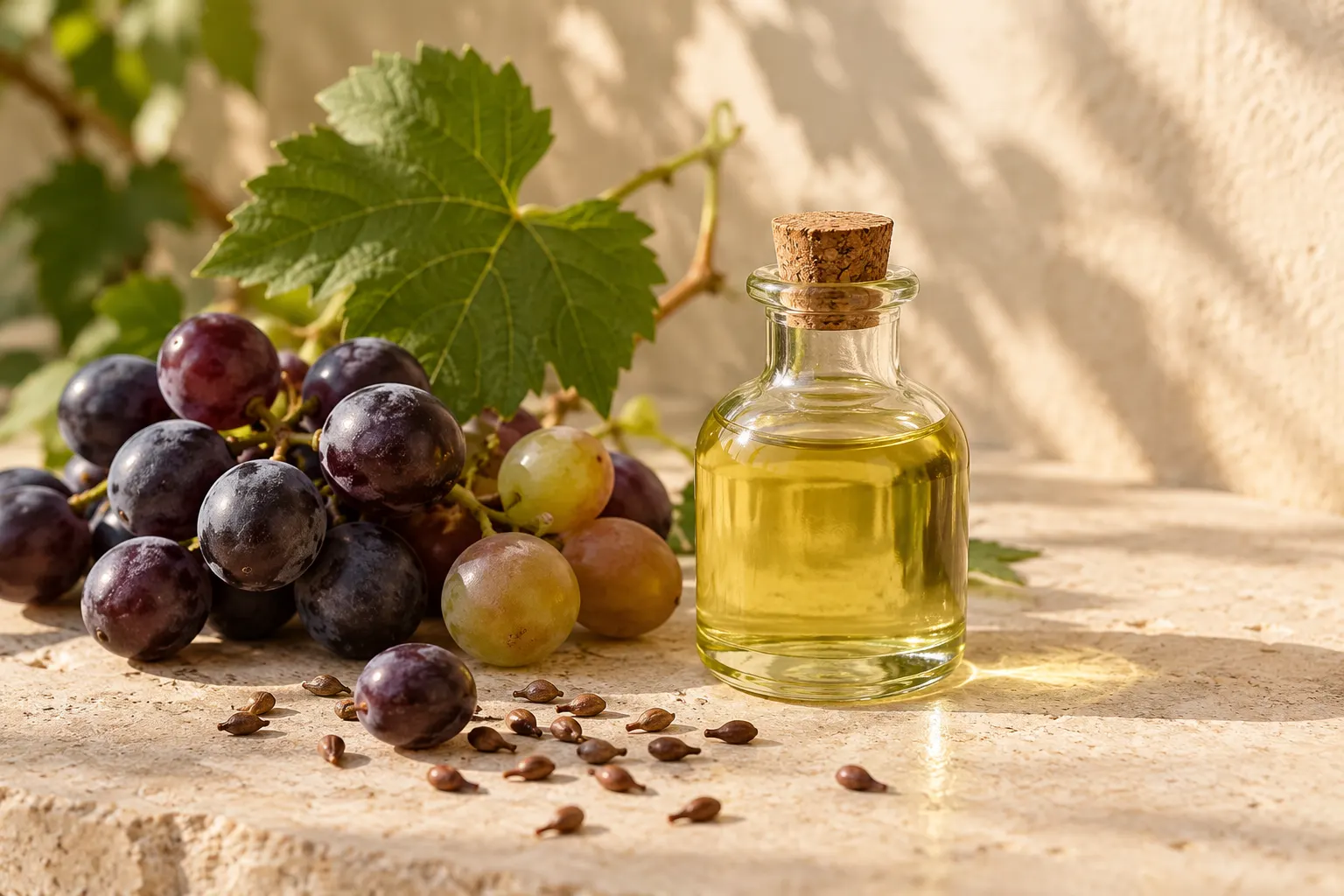
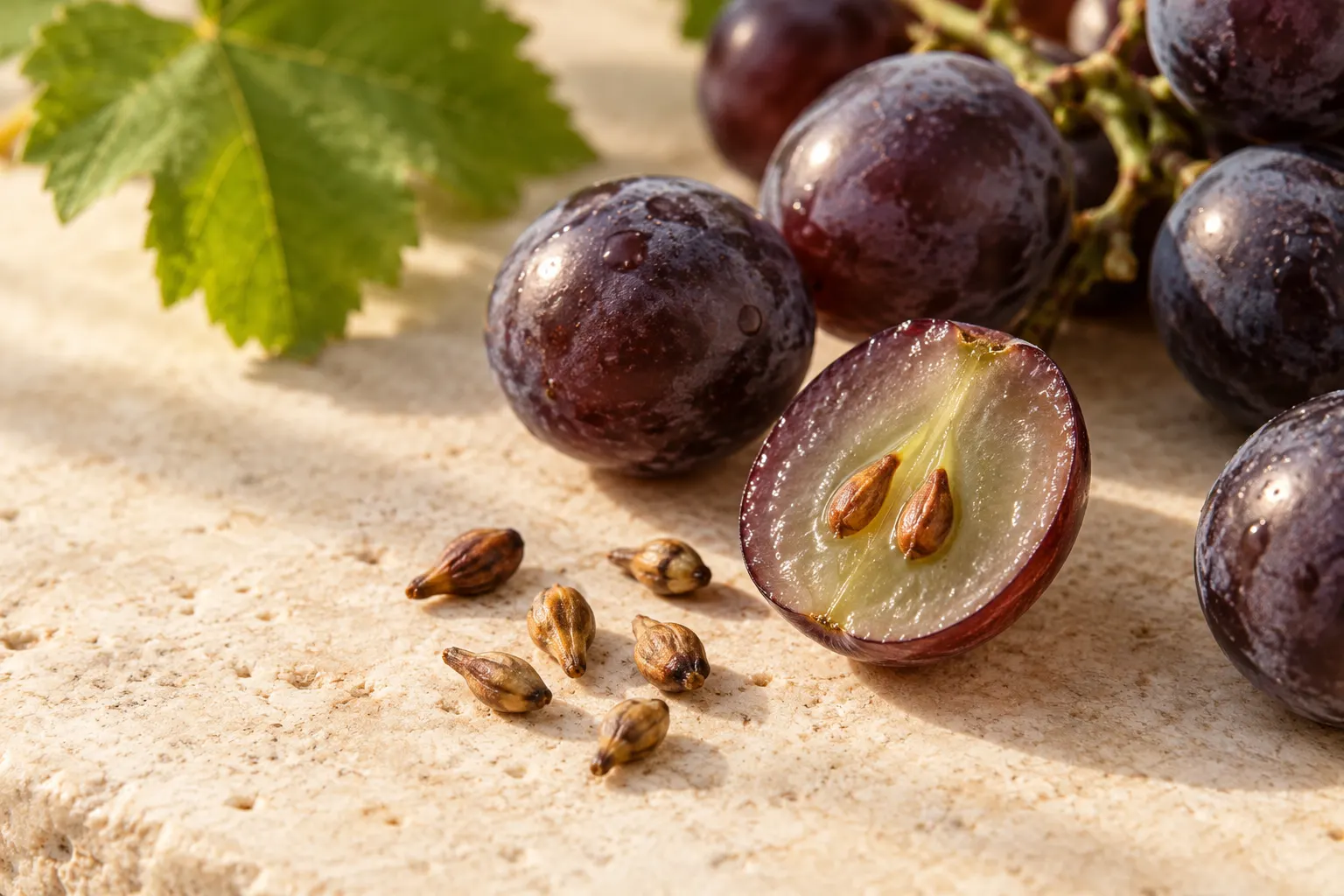
Grapes offer more than juice and wine. The small seeds inside each berry also contain oil used in food and cosmetic products. This gives a less visible part of the vineyard's harvest a new purpose. [2]
Interest in grape seed oil for hair care comes from its fatty acid composition and research on the hair shaft. To get to know this ingredient, it helps to understand what the oil actually contains, which properties have been measured, and how it might fit into a daily routine.
From a small seed to a cosmetic ingredient
On product ingredient lists, this ingredient is often called Vitis Vinifera (Grape) Seed Oil. This is also the name under which it appears in the Cosmetic Ingredient Review database. [1]
The material left after grapes are processed for winemaking also contains seeds. Separating them and extracting their oil is one way to make further use of this material. A 2020 review discusses grape seed oil as a valuable resource associated with the wine industry. [2]
Various methods are used to extract the oil, including mechanical pressing. The grape variety, seed maturity, and processing of the raw material also affect its final composition. Oils bearing the same name therefore do not always have identical chemical profiles. [2]
Linoleic acid defines its profile
One of the distinctive components of grape seed oil is linoleic acid. It is a polyunsaturated fatty acid in the omega-6 family. The oil also contains oleic acid, although the ratio of these fatty acids varies between samples. [3]
A study published in Food Chemistry in 2011 examined four types of cold-pressed grape seed oil. Linoleic acid accounted for 66.0% to 75.3% of their total fatty acids. [3]
These figures apply to the specific samples tested. They offer a useful picture of the oil's general chemical profile, but do not tell us the exact composition of a finished hair care product: the amount of oil in the formula and its other ingredients also matter.
Vitamin E compounds, including tocopherols and tocotrienols, have also been described in grape seed oil. The presence of these components makes the ingredient interesting, but appropriate testing is needed to assess any particular effect on hair. [2]
Seed oil and seed extract are different materials
Seeds contain both fatty compounds and other types of substances. When these are separated, different components may predominate in the resulting products. We therefore cannot assume that grape seed oil and an extract obtained from the seeds have the same composition.
In the same 2011 study, researchers also compared the oils with defatted seed flours. The total amount of phenolic compounds was significantly lower in the oils than in the flours. This example shows why it is so important to know exactly which material was studied. [3]
An interesting finding about a particular seed extract therefore does not automatically describe the effects of ordinary oil. When assessing a product, it helps to distinguish between the names of oils and extracts on its ingredient list.
Grape seed oil in hair care
Grape seed oil has also been studied directly on hair samples. A paper published in ACS Omega in 2023 compared the effects of grape seed, safflower seed, and rosehip oils on natural, damaged, and dyed hair. [4]
After shampooing and treating the samples with oils, the researchers measured shine, changes in color, and mechanical properties. They also used electron microscopy to examine the hair surface and fractures. [4]
Grape seed oil showed interesting results in some shine measurements and microscopic assessments. Other oils stood out in certain other measurements. Results also depended on the type of hair and the measurement method. [4]
This paper gives us a basis for considering the oil in the context of cosmetic care for the hair shaft. The study was conducted on laboratory samples and cannot reproduce every detail of an individual's daily use.
When processing changes the oil itself
A study published in Scientific Reports in 2025 examined fermented grape seed oil. The researchers observed how fermentation changed the oil's composition and assessed its penetration into the hair shaft. [5]
In a test using a fluorescent label, the fermented oil showed higher penetration measurements than ordinary grape seed oil. The researchers also assessed the structural and mechanical characteristics of damaged hair. [5]
The key detail here is the processing. The fermented ingredient was an experimental material with an altered composition. It would not be accurate to apply its results directly to any grape seed oil or finished product.
The treatment protocol used in the study is not a set of instructions for daily care, either. The new findings show potential for developing the ingredient, while practical directions for use should match the specific product.
What can we expect from daily care?
The condition of the hair's outer surface affects friction, ease of combing, and how it feels to the touch. Reviews of hair conditioning discuss oils as one component of surface lubrication and care. [6]
Practical goals may therefore include greater softness, easier combing, and a well-cared-for appearance. Results depend on the ingredients, their proportions, the amount used, and the condition of the hair. [6]
Assessing the shine or strength of the hair shaft is not the same as measuring new hair growth. The hair studies discussed here do not provide clinical confirmation of accelerated growth on the human scalp. [4] [5]
The most useful expectations are specific: assess how pleasant your hair feels to the touch, how easily it combs, and whether the amount used weighs it down.
Care starts with a small amount
Use a product containing grape seed oil according to its intended purpose. Pure oil, a rinse-out mask, and a leave-in blend may have different instructions.
- Start with a small amount and observe how your hair feels.
- Following the directions, distribute a leave-in product evenly through the lengths and ends.
- If your hair feels weighed down or greasy, reduce the amount.
- Store the product under the conditions stated on its packaging and close it securely after use.
- Combine oil-based care with gentle combing and a routine suited to your hair's needs.
The overall formula and how well a product suits your hair matter more than the name of a single ingredient. Even distribution and a moderate amount make this easier to assess.

A vineyard resource for thoughtful care
Grape seed oil brings together an interesting origin, a profile rich in linoleic acid, and opportunities for research on the hair shaft. Getting to know it reminds us that even a familiar plant can have less familiar cosmetic uses.
When we discuss ingredients like this on the DIVARA blog, we believe it is important to connect their origins, actual measurements, and directions for use. This knowledge helps us make more informed choices about care.
A useful way to assess grape seed oil is to know exactly which material was studied, what was measured, and how closely those findings relate to the product we choose.
References
1. Cosmetic Ingredient Review. Vitis Vinifera (Grape) Seed Oil: ingredient name and entry.
View the ingredient entry - CIR
2. Martin M.E. et al. (2020). Grape seed oil: origin, composition, and its connection to the wine industry. Foods, 9(10), 1360.
Review of composition and origin - PubMed Central
3. Lutterodt H. et al. (2011). Fatty acids, stability, and laboratory properties of cold-pressed grape seed oils and defatted flours. Food Chemistry, 128(2), 391-399.
4. Demir E., Acaralı N. (2023). Comparison of grape seed, safflower seed, and rosehip oils on different hair types. ACS Omega, 8(9), 8293-8302.
Study on hair samples - PubMed Central
5. Wu N. et al. (2025). Study of fermented grape seed oil penetration and its effects on damaged hair. Scientific Reports, 15, 22175.
6. Dias M.F.R.G. (2015). Hair Cosmetics: An Overview. A review of hair conditioning mechanisms and care ingredients. International Journal of Trichology, 7(1), 2-15.
View the hair care review - PubMed Central
This article is for educational purposes. Ordinary oil, extract, and fermented oil are different materials. The studies discussed are not clinical trials conducted on a finished DIVARA product.